


Imagine a program whose goal is to keep the elderly in their homes and provide all the care required – medical appointments, medications, physical and occupational therapy needs, transportation, help with meals, laundry and self-care. If the elderly person is admitted to the hospital or needs to go to the ER, the program would choreograph the discharge plan, including arranging all the follow up doctor’s and other health care appointments, follow up testing, and ensuring that any changes to medications are included in the plan of care.
Imagine that such a program is free to those who can least afford it; those who are able would pay a nominal fee.
Most folks –even physicians and patient advocates!–don’t know that such a program exists: the Program of All-Inclusive Care for the Elderly (PACE).
It is, my physician colleague Dr. Lisa Adams shared with me, ”the best kept secret in Massachusetts.” She learned of the program from her elder law attorney: Lisa’s sister “June” has complex medical needs, including Type II diabetes, that often land her in the hospital. Caring for her sister used to absorb hours of Lisa’s time; every few months, Lisa found herself needing to drive to Boston when her sister was admitted to the hospital, help plan her discharge and drive her home–not to mention then figuring out how to get her sis to all of her follow up doctor’s appointments–all the while working full time in Vermont. Her sister was adamant about not wanting to go to a nursing home and losing her independence.
Enter the PACE program. “As a physician and primary caretaker of my physically ill sister and living 2.5 hours away, I do consider it a life saver,“ Lisa shared with me.
Now Lisa will get a call from the PACE social worker when her sister is admitted to the hospital. The team will let her know what the discharge plan is and that they have arranged her sister’s transportation home. The social worker schedules her sister’s follow-up doctor’s appointments–and her transportation to those appointments. It is such a huge relief, Lisa said, not to worry about all of these details.
PACE Operates Nationwide
Jim reached out to me because his family faced a similar dilemma.
Jim and his siblings provide financial support to their 91-year-old aunt, “Josie,” who lives in another state — a 17 hour drive from Jim’s home in Boston. Josie can still live independently, but he and his siblings are concerned about the future and the additional support she will likely need. Jim feels she’d benefit from additional services like meal preparation, housekeeping and laundry. “Might any of these independent living services be covered by her existing health insurance?” he asked me. “Does she qualify for Medicaid? And who can help my family find answers to these questions?”
When I asked geriatrician Dr. Anne Fabiny for suggestions, she immediately mentioned the PACE program, and reminded me that the program doesn’t just operate in Massachusetts but nationwide. Dr. Fabiny ran the PACE program in Cambridge before she moved to San Francisco to set up a similar program at the VA hospital there.
The PACE program staff, she said, could evaluate Josie’s eligibility, both financial and medical. If Jim’s aunt qualifies for Medicaid and PACE, she can enroll in PACE for free. The staff can help her apply for Medicaid benefits or tell her what she would need to do to qualify. If Jim’s aunt doesn’t qualify for Medicaid, she can pay a monthly fee to enroll in PACE and receive services. She would have to transfer her Medicare benefits over to the PACE program as well as switch all her health care to the PACE program.
Jim’s aunt is exactly the sort of patient who the PACE serves: the independent elderly who would like to stay in their home but require support to do so.
When I compare the beautifully coordinated care provided to Lisa’s sister to that of many of the patients I advocate for, the contrast is stark. June leaves the hospital with transportation home arranged-–and all of her follow up testing and medical appointments, too. Any medication changes are automatically communicated to and made by the PACE pharmacist and provided to Lisa’s sister.
Recently, after the hospital discharge of their 23 year old son, his family reached out to me, bewildered at the complexity: who was going to arrange the follow up doctor’s appointments? Would the doctors reach out to their son? Many of the new doctors required referrals, they discovered, that they then had to request through their PCP. In the meantime, who was coordinating all the new medications their child had been started on? Who would arrange the testing that had been recommended? How should they prioritize? They were truly lost.
Why couldn’t the kind of care coordination provided by the PACE program be provided for ALL patients, of every age? Imagine a medical system focused on these critically important aspects of patient care. For the elderly, imagine a system that prioritizes keeping them in their home, allowing them to preserve a sense of identity; imagine a system that gives the elderly the support they need to live independently, a system that provides preventive care and other supports to keep them mentally and physically healthy. The alternative is not working well.
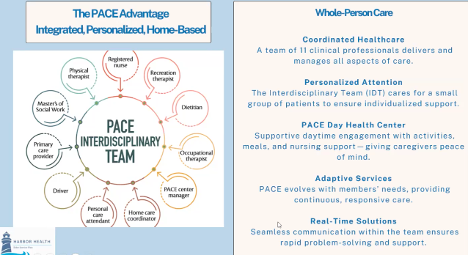
| Visiting a PACE Program: Harbor View Many of the PACE programs are located at Community Health Centers, like the Harbor View program in Mattapan that I visited with a group of patient advocates. We met with the staff physician, Dr. Ilona Kopits, Senior Medical Director of the PACE Elder Services, and PACE staff Julie Richer, who gave us a tour of the impressive facilities. We toured the spacious lunchroom; the well-equipped PT and OT area and exam rooms and the day program where the elderly are provided with meals and entertainment. To Jim’s question about assistance for his aunt–they also will do laundry for patients and help them with showering and selfcare. There are usually also PT/OT etc. at those facilities; and there is transportation to and from the adult day health center. A pharmacist is also part of every PACE program and PACE health care team. Julie Richer, who offered us a tour, discussed the many advantages of the PACE program. Julie and Iliona noted that one of the unique things about the PACE program is that the care providers communicate. The approach is interdisciplinary; clinicians meet every day to discuss the patients’ care. At any given time, Harbor View cares for 150-200 patients. Julie said the program really helps take pressure off family members, since the burden of care coordination increases dramatically as health issues become complex. They also offer a day center, where patients can spend the day supervised, receive their medications, bathe, and have access to medical, PT and social work appointments. The patient will also receive transportation home. Sometimes, if there is need, they may have an aide at home help them for an hour in the evening to get ready for bed. The key piece is that the day center and providers are all integrated. She notes that when patients join PACE, they don’t necessarily need all the services provided–but as time goes by and their needs progress, they often do. This is helpful, because they don’t need to search, for example, for physical therapy–it is provided right there. There is a also, she said, a team who supervises discharge and return home after hospitalization It is a unique system, she said, because they act as the provider of care and care payer, since their services are funded by Medicare and Medicaid. That gives them the flexibility to decide what care is needed –there are no pre-authorizations required. The patient demographic, she said, includes patients as young as 55, who can join if they are eligible. The program is accessible to younger patients also: there are special needs plans that States can offer people younger than 55 who have Medicare and other qualifying conditions. Those who join PACE must switch their primary care to the physicians and nurse practitioners who are part of the program. Every PACE program has a network of specialists it works closely with. PACE programs don’t exist in every state, and in some places where there is great need, there are not many, or any, PACE programs. One of my advocate colleagues lamented in an email that there is “only one DC PACE program. It opened in mid-2023 after a lot of legal hoops to get there. While there is a lot of need, they only provide services in two of the eight wards in DC. Every expansion has been met with more and more red tape with less and less funding. How disappointing,” she said, “that we know how to make the lives of our most vulnerable people so much better but that it is so difficult to get!” And as Julie Richer suggests in the above talk, even in Massachusetts, the PACE programs can do a better job of serving the homeless and especially the immigrant populations they were originally founded to help. But overall–I came away from learning about the PACE programs tremendously impressed with the excellent job the physicians and staff there do in keeping patients at home and coordinating their care. It occurred to me that ALL of the elderly could benefit from such a program. As one of the advocates who attended Julie’s talk pointed out to me–as advocates, we spend tremendous amounts of time finding caregivers and clinicians to fill all the roles that PACE provides. Imagine having all of these services available under one umbrella–and not having to obtain referrals and insurance approvals for each service. |
| History of PACE PACE began in California in the early 1970s as a solution to the very questions and concerns Jim and Lisa experienced. It was the brainchild of Marie-Louise Ansak, who had been hired by a Chinese community committee to set up a nursing home for immigrant families struggling to care for aging parents. Instead, she advocated for providing comprehensive medical, dental, social, and day services that would help keep elderly family members at home, in keeping with their culture. It eventually became a Medicare demonstration project that was so successful it became the only clinical program run by the Medicare program. PACE then expanded its mission to provide support to keep the elderly at home nationwide. Funded by Medicaid and Medicare, it pays for itself many times over: since there is better coordination of care, patients have far fewer ER visits (one or less a year), which saves thousands of dollars. Because there is more socialization, patients who participate in PACE are also in better mental health. The elderly who stay in their home do not experience the stress of relocation, which can be significant. National PACE runs 202 programs serving more than 95,500 participants in 33 states and the District of Columbia; the link to “find a PACE program” search engine is here. The Program of All-Inclusive Care for the Elderly (PACE) averts an estimated tens of thousands of ER visits annually. Data shows the average PACE participant has less than 1 emergency room visit per year, performing significantly better with lower ER usage than traditional Medicare and equivalent care plans. Why PACE is so Effective at Preventing ER Visits The National PACE Association attributes these averted visits to the proactive and integrated model of the program: ● 24/7 Access: Participants have immediate access to a round-the-clock nursing care line, allowing them to consult experts before making unnecessary, stressful trips to the emergency room. ● Integrated Care Teams: PACE interdisciplinary teams (doctors, nurses, therapists, dentists and social workers) are stationed under one roof, regularly checking small health problems before they escalate into emergencies. ● Preventive Care Emphasis: The program delivers rigorous preventative services, such as routine hearing and vision screenings, fall reduction physical therapy, and medication management. |
Acknowledgement: I am grateful to Dr. Anne Fabiny for her very helpful editorial input.
Medical Disclaimer:
The suggestions given here are not intended as a substitute for the medical advice of your physician. The reader should regularly consult a physician in matters relating to health and particularly with respect to any symptoms that may require diagnosis or medical attention. For additional questions, please call your healthcare provider for reliable, up-to-date information on testing and symptom management of all medical concerns.
Photo credit: many thanks goes to Lukas S from Hamburg; from photos free to use and share posted on Unsplash.com.
